Stock Ledger
On this page
The Stock Ledger follows one item through a period. It starts from the stock the item had on the first day, lists each purchase, sale, return and damage in date order with the balance after it, and ends with the closing stock. Use it to find out where an item’s stock went, or why the count on the shelf and the count in SimplyERP differ.
Open the report
Press Alt+5 for Stock Reports, then A. The cursor is in the Item field. Type part of the item’s name, its code, its company, its technical name or its register page number and the list shows the best matches first; F2 lists every item. Press Enter on the item you want.
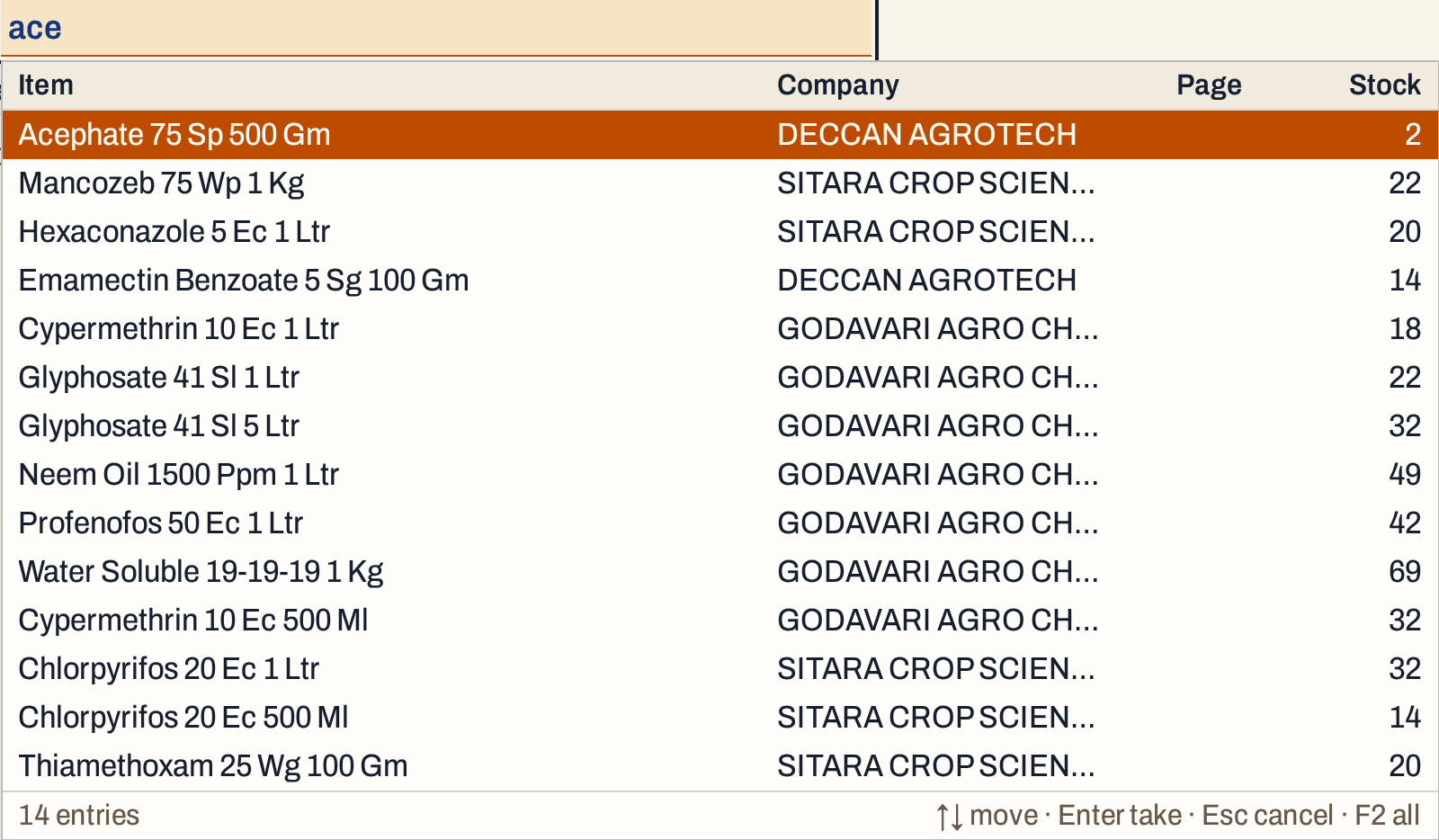 The list shows each item’s company, register page and the stock it has now. A negative stock shows in red.
The report opens for the financial year from its first day to today. Until you choose an item the grid says “Choose an item.” The screen below shows one item for October.
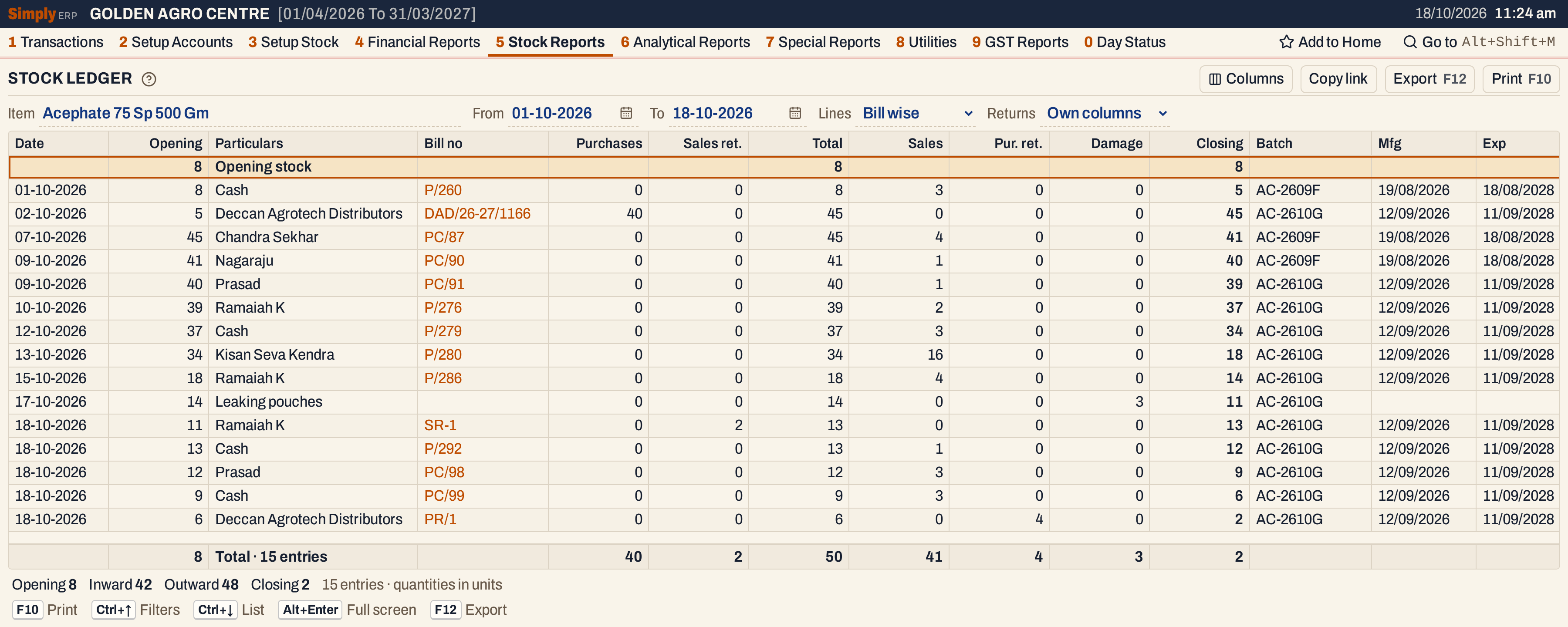 Each line shows the stock before it (Opening), what came in, what went out and the stock after it (Closing). The status line gives the totals: opening 8, inward 42, outward 48, closing 2.
What it lists
One line for each stock movement of the item in the period. A line stands for one bill, one goods entry or one damage entry. It reads:
- Sale bills, purchase bills, sales returns and purchase returns of the item. A sale bill or purchase return counts on its own date. A purchase bill or sales return counts on the day the goods were received, the Recd. date on the bill. Only the item lines of a bill count; charge lines do not. Other documents, such as GST notes, do not move stock.
- Goods in and out entered in Goods In / Out (D.C.) (1 P), on the date of the entry. Goods received are shown as purchases, goods delivered as sales, and returns in or out as sales returns or purchase returns. When the bill for goods already received arrives, only the units not received before count, so the stock is not counted twice.
- Damages and breaks entered in Damages / Breaks (1 V), on their date, in the Damage column.
Quantities of the same kind on one day with the same bill number and batch are added into one line: a bill with the item twice in one batch is one line, and two damage entries of one day and batch are one line. A bill whose units were all received before on a challan has no line, as nothing is left to count.
The first line is the Opening stock. It is the item’s opening stock (Opening Stock, 3 G) plus every movement before the From date.
The balance runs from the first day of the books, not from the From date, so the opening line is right for any period you choose.
Within one day the lines come in this order: purchases, sales returns, sales, purchase returns, damages. Lines of the same kind are in the order of their bill numbers read as text, so P/292 comes before PC/98 and P/101 before P/20.
Columns
| Column | What it shows |
|---|---|
| Date | The date the movement is posted on. |
| Opening | The stock before this line. On the opening line, the opening stock. |
| Particulars | The name of the party on the bill or goods entry, or the note of a damage entry. In Summary, a day’s sales are one line named SALES. |
| Bill no | The bill number, or the challan or reference of a goods entry. Bills show in colour because Enter opens them. |
| Purchases | Units bought on a purchase bill or received as goods. (Own columns layout) |
| Sales ret. | Units a customer returned. (Own columns layout) |
| Total | Opening plus what came in on this line. |
| Sales | Units sold on a sale bill or delivered as goods. (Own columns layout) |
| Pur. ret. | Units returned to a supplier. (Own columns layout) |
| Damage | Units lost to damage or breakage. It appears only when the item has a damage entry in the period. (Own columns layout) |
| Inward | Purchases plus Sales ret. (In inward / outward layout) |
| Outward | Sales plus Pur. ret. plus Damage. (In inward / outward layout) |
| Closing | The stock after this line. Negative balances are red. |
| Batch, Mfg, Exp | The batch of the line and its manufacturing and expiry dates. They appear only when some line in the period has a batch. A damage entry shows the batch but no dates. |
The line under the grid adds up the figures of the period and counts the entries. The status line repeats the totals as Opening, Inward, Outward and Closing, and shows the item’s register page as Page no when it has one. All quantities are in units.
Choices
| Choice | What it does |
|---|---|
| Item | The item to show. Choosing another item reloads the report. |
| From, To | The period, both days included. Both dates must fall in the financial year. If you set From after To, To moves to the same day. |
| Lines | Bill wise (the usual): one line for each bill or entry. Summary: a day’s sales on one line. |
| Returns | Own columns (the usual): purchases, sales returns, sales, purchase returns and damage each in a column. In inward / outward: only Inward and Outward. |
| Columns | Hides the Particulars, Bill no, Batch, Mfg or Exp column. The print leaves them out too. |
Every choice is kept in the page address, so Copy link gives a link that opens the same ledger.
 The two choices that change the layout.
How the figures are worked out
For each line:
- Total = Opening + Purchases + Sales ret.
- Closing = Total − Sales − Pur. ret. − Damage.
- The next line’s Opening is this line’s Closing.
For the first line of the period, Opening is the item’s opening stock plus all earlier purchases and sales returns, less all earlier sales, purchase returns and damage.
In the example, the opening stock of 8 on 01-10-2026 is followed by a sale of 3 (bill P/260), which leaves 5. The purchase of 40 on 02-10-2026 (bill DAD/26-27/1166) makes the total 45.
The totals under the grid add up the movement columns over the lines. Opening is the period’s opening stock, Total is that opening stock plus Inward (8 + 42 = 50) and Closing is the stock at the end. Inward is Purchases plus Sales ret., Outward is Sales plus Pur. ret. plus Damage, and the closing stock is the opening stock plus Inward less Outward: 8 + 42 − 48 = 2. When the period has no movement, the opening and closing stock are both the standing balance of the item.
The last lines of the example show the returns and the damage. On 17-10-2026 a damage entry of 3 (“Leaking pouches”) takes the stock from 14 to 11. On 18-10-2026 a sales return of 2 (SR-1) brings it to 13, three sale bills of 1, 3 and 3 units take it to 6, and a purchase return of 4 (PR/1) leaves 2.
Summary
With Lines set to Summary, all the sales of a day are added into one line.
- A day with sales and no receipt gets a line named SALES, with no bill number or batch.
- A day that also has a purchase or a sales return puts the day’s sales on the last of those lines, so the line keeps that party and bill number and its Closing is the stock after all the day’s sales.
- Purchase returns and damages stay on their own lines.
- Enter on a line that carries the day’s sales together with a purchase or sales return opens the bill of that purchase or return.
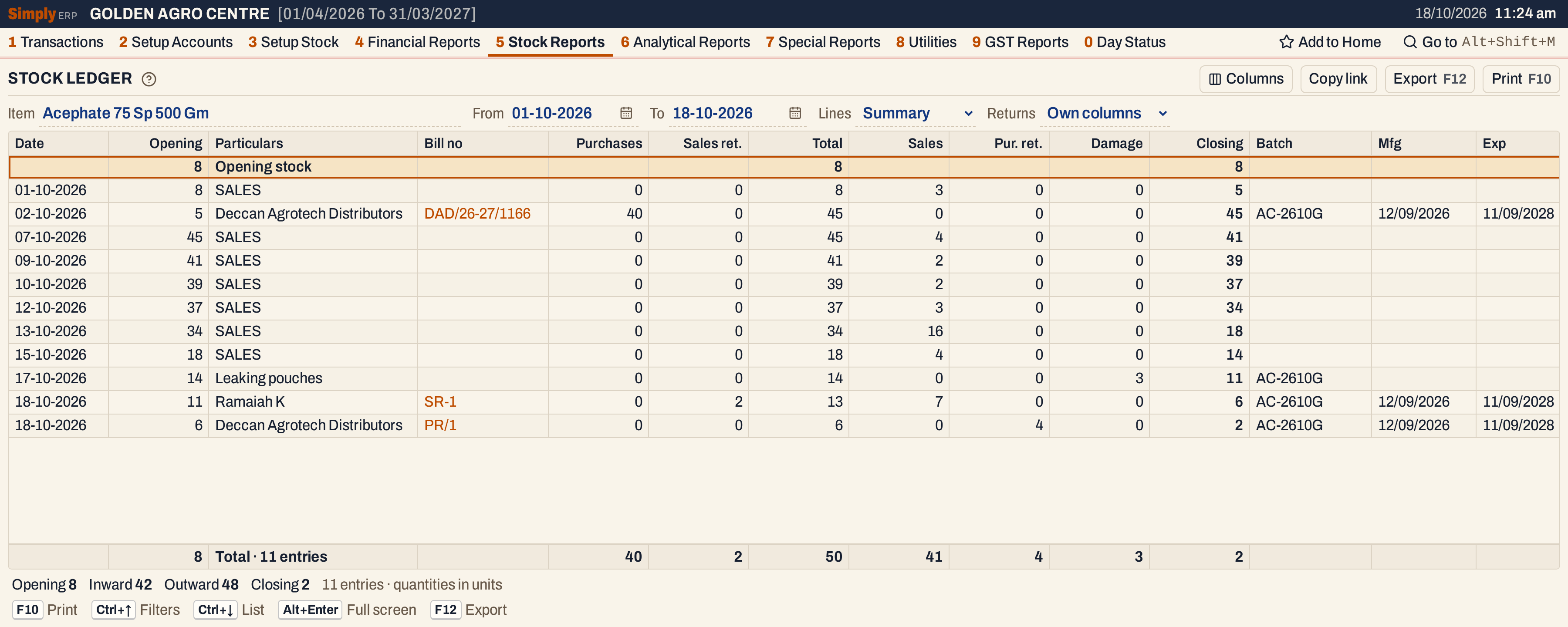 On 18-10-2026 the three sale bills of 1, 3 and 3 units appear as 7 sold on the line of the sales return SR-1. The total line still reads 41 sold and a closing stock of 2.
Inward / outward
With Returns set to In inward / outward the report has five figure columns: Opening, Inward, Total, Outward and Closing. The sales returns are in Inward and the purchase returns and damage are in Outward.
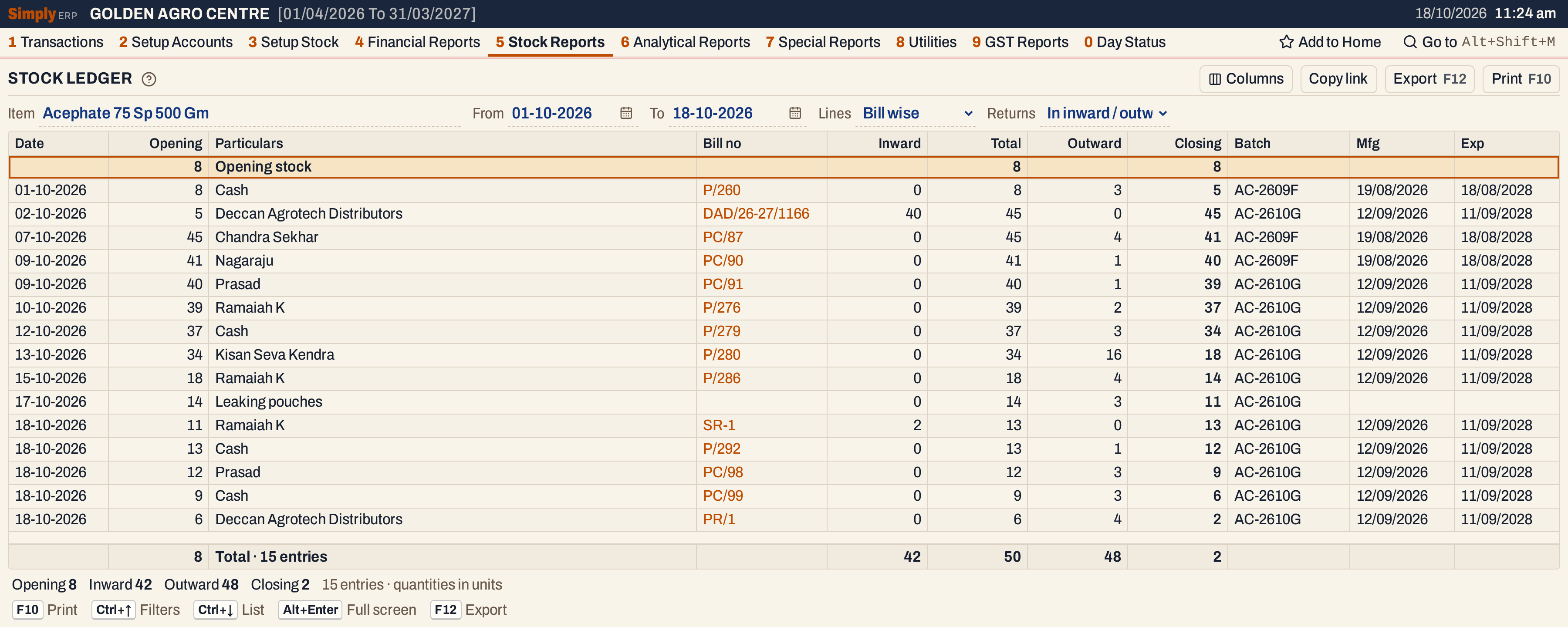 The same movements with the returns folded into Inward and Outward.
Open, print and export
- Enter on a bill line opens the saved bill. Back returns to the same line. Lines for goods entries and damages have no bill and stay where they are.
- Enter on a SALES line in the Summary opens that day bill by bill.
- Type letters in the grid to jump to the next party that begins with them.
- F2 in the Item field lists every item.
- F10 prints the ledger as it is on the screen. The heading is the item’s name with STOCK REGISTER, the period and the opening stock, with the register page when the item has one, and your choices are listed under it. The columns are headed Date, Open.Stock, Particulars, Inv.No, Bat.No., Mfg Date and Exp Date, then Purchase Qty, Sales Retns, Total Qty, Sales Qty, Purch. Retns, Leaks and Closing Stock (Inward Qty, Total Stock, Outward Qty and Closing Stock in the inward / outward layout). The last lines give the totals and the Closing Stock.
- F12 saves it as an Excel workbook.
- Alt+Enter gives the whole window to the list.
Updated 4 November 2026.