Trading Account
On this page
The Trading Account sets what you sold, plus the stock you still hold, against the stock you started with and what you bought. What is left over is the gross profit, before any expense of running the shop. It is the first of the three final accounts: the Profit & Loss Statement carries its gross profit forward, and the Balance Sheet carries the closing stock.
Open the report
Press Alt+4 for Financial Reports, then F. The report opens as on today. If today is outside the financial year, it opens as on the year’s last day (or its first day, if today is before the year starts).
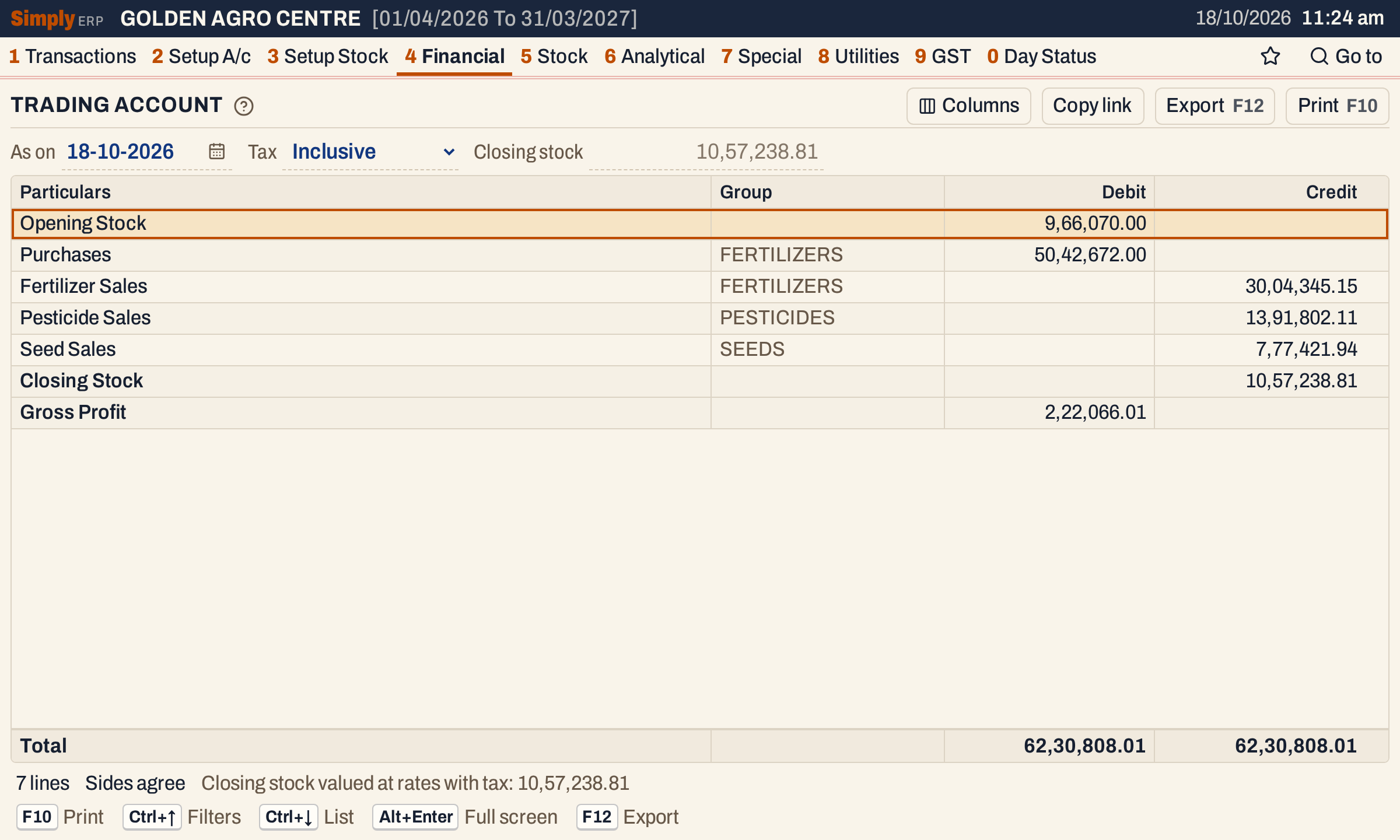 Debit and Credit each total 62,30,808.01. The status line says Sides agree.
What it lists
One line for each account that the books mark as a trading account, and has a balance on the As on day:
- accounts of the types Sales, Sales Returns, Purchases, Purchase Returns, Opening Stock, Closing Stock, Direct Income and Direct Expense belong here unless you say otherwise. The Statement field in an account’s form (see Add an account) can put any account on the Trading Account, the Profit & Loss Statement or the Balance Sheet;
- the sales and purchase accounts that your bill books post to, the returns accounts, and the Opening Stock account.
The balance of an account is everything posted to it up to the end of the As on day, opening balance included. An account whose balance is nil is left out. A balance that is a credit goes on the Credit side and a debit balance on the Debit side, so a Sales Returns account shows on the Debit side.
The lines are in order of Group (accounts with no group first, then A to Z). Within a group, the purchase accounts come before the sales accounts, and accounts of the same kind are in name order.
After the accounts come the lines SimplyERP works out:
- Closing Stock, on the Credit side, when it is not nil;
- Gross Profit on the Debit side when the credits (with the closing stock) are more than the debits, or Gross Loss on the Credit side when they are less.
The report does not read bills one by one; each account’s balance is what the bills, notes and vouchers posted to it add up to.
Columns
| Column | What it shows |
|---|---|
| Particulars | The account’s name (its trade name if it has one). The special lines are in bold: Closing Stock and Gross Profit or Gross Loss. |
| Group | The item category of the bill book that posts to the account (FERTILIZERS, PESTICIDES, SEEDS). When bill books of several categories post to one account, it shows the first category in A to Z order: Purchases is posted to by all three and shows FERTILIZERS. Blank for the Opening Stock account and for accounts no bill book posts to. The Columns button hides it. |
| Debit | The account’s balance when it is a debit, and the Gross Profit. |
| Credit | The account’s balance when it is a credit, the Closing Stock and a Gross Loss. |
The totals line adds up Debit and Credit. The two totals are always equal, because the gross profit or loss is the difference between them. The status line under the grid gives the number of lines and either Sides agree or, if they differ, how much and on which side. It also says how the closing stock was reached: Closing stock valued at rates with tax, Closing stock valued at rates before tax or Closing stock as typed, with the amount.
Choices
| Choice | What it does |
|---|---|
| As on | The day the account is drawn up to. It must fall in the financial year. Default: today, kept inside the financial year. |
| Tax | Inclusive (the usual) values the closing stock at purchase rates with tax. Exclusive values it at purchase rates before tax. |
| Closing stock | Empty by default, where the grey figure shows the valuation. Type an amount (0 or more) to use it instead of the valuation. Clear it to go back to the valuation. |
 The choices above the grid. The grey figure in Closing stock is the valuation SimplyERP worked out.
Every choice is kept in the page address, so Copy link gives a link that opens the same report.
Rates before tax
Choose Exclusive and the closing stock is valued without the tax in its purchase rates, so it is lower and the gross profit is lower by the same amount.
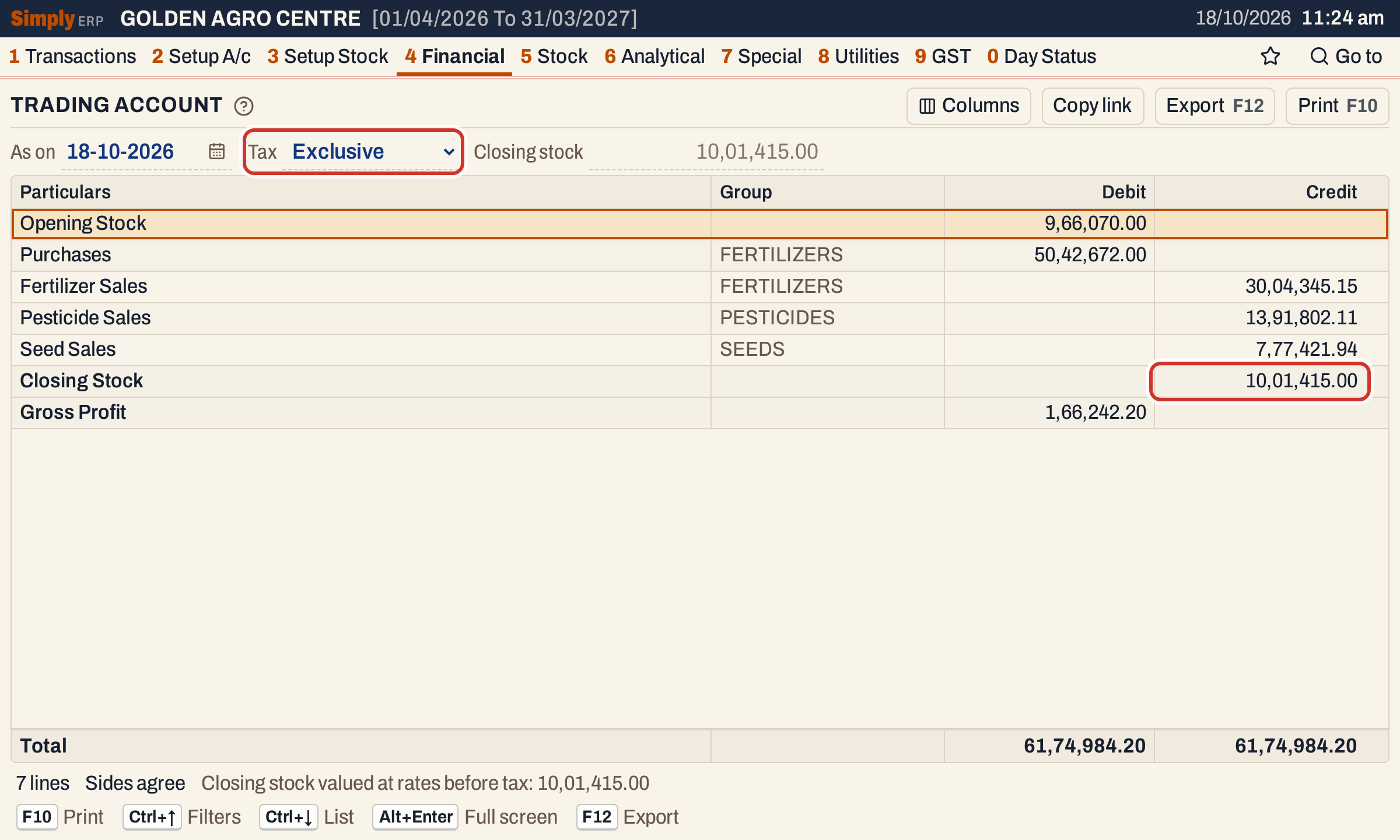 With Exclusive, the closing stock falls from 10,57,238.81 to 10,01,415.00 and the gross profit from 2,22,066.01 to 1,66,242.20. Nothing else on the report changes.
A closing stock you type
Type an amount in Closing stock and press Enter (or move out of the box). The Closing Stock line takes that amount and the gross profit follows it. The status line then says Closing stock as typed. Use it when you have counted the stock and want the gross profit worked out from your own value.
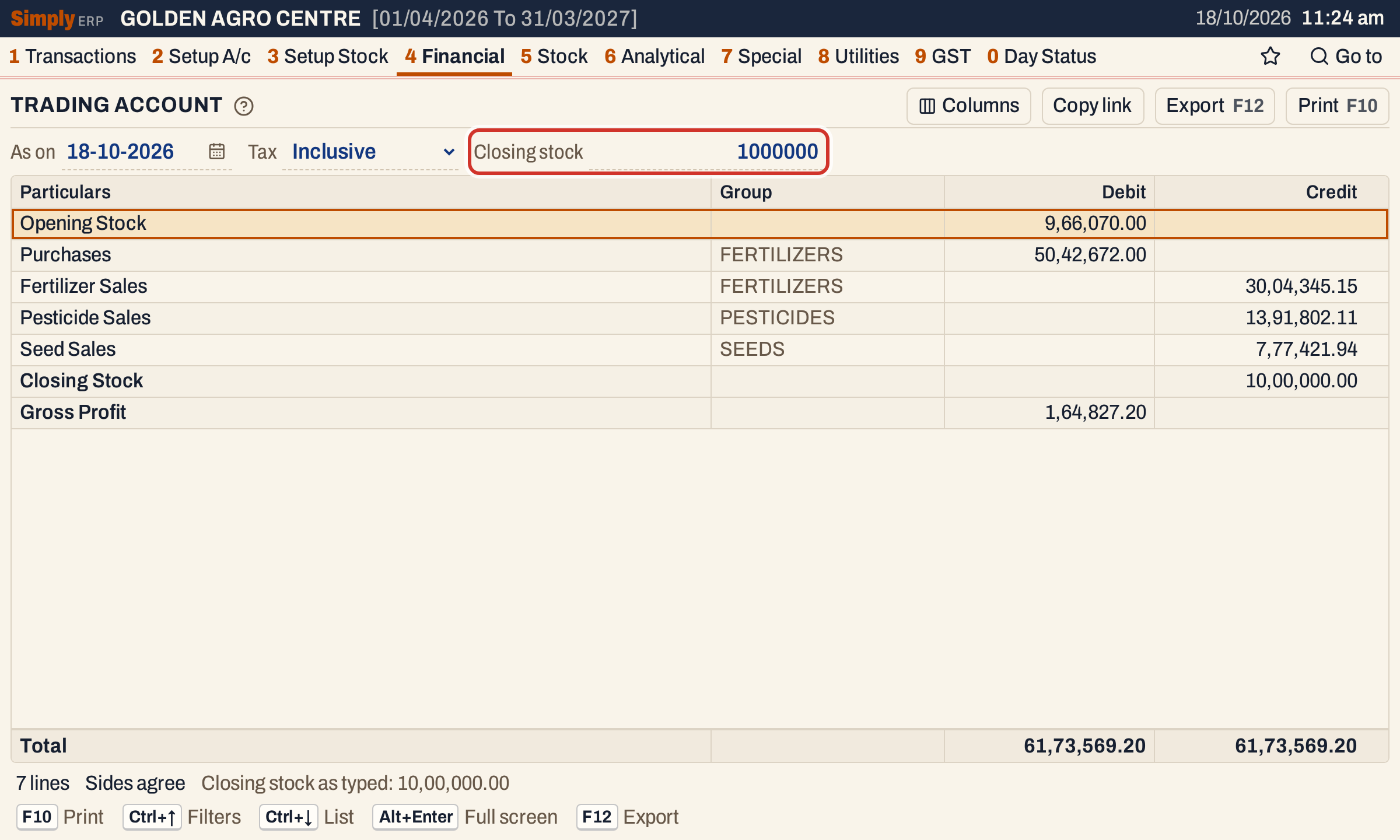 A typed closing stock of 10,00,000 gives a gross profit of 1,64,827.20. The amount is kept in the page address only; it is not saved in the books.
How the figures are worked out
Accounts. For each trading account, SimplyERP adds its credits and subtracts its debits, over everything posted up to the As on day. A positive result is the account’s credit balance and a negative one its debit balance.
Gross profit.
- Debit side = the accounts with debit balances (opening stock, purchases, sales returns and the like).
- Credit side = the accounts with credit balances (sales, purchase returns and the like) + the closing stock.
- If the credit side is the larger, Gross Profit = Credit side − Debit side, and it is added to the Debit side. Otherwise Gross Loss = Debit side − Credit side, and it is added to the Credit side. Both sides then total the same.
For the books in the picture:
- Debit side: opening stock 9,66,070.00 + purchases 50,42,672.00 = 60,08,742.00.
- Credit side: sales 30,04,345.15 + 13,91,802.11 + 7,77,421.94 = 51,73,569.20, plus closing stock 10,57,238.81 = 62,30,808.01.
- Gross Profit = 62,30,808.01 − 60,08,742.00 = 2,22,066.01.
The opening stock is not worked out from the stock; it is the balance of the Opening Stock account. The closing stock is not read from any account either; it comes from the valuation below, or from the amount you type.
Closing stock valuation. SimplyERP values every stock item that has a positive quantity on the As on day:
- The quantity is the item’s opening stock + purchases + sales returns − sales − purchase returns − damages and breaks, up to and including the As on day. Goods received or delivered in Goods in and out count too, and a bill’s quantity that was already received or delivered there is not counted twice. An item whose quantity is nil or negative adds nothing.
- Those units are valued from the latest purchases back. The units of the newest purchase bill dated up to the As on day are valued at that bill’s unit cost, then the next newest, until the quantity is covered. With Inclusive the unit cost is the purchase line’s cost with its tax (and its share of any charges the bill spreads over its items); with Exclusive it is the line’s price before tax. A purchase line without a cost is skipped.
- Units still not covered, such as the opening stock, are valued at the item’s opening price, the Op. price on its packing line. The Tax choice does not change this rate.
- Each item’s value is rounded to paise, and the closing stock is the total of all items.
The picture shows how one item is valued: Dap 18-46-0 50 Kg has 204 units, 200 at 1,312.50 from the latest purchase and 4 at 1,286.25 from the one before.
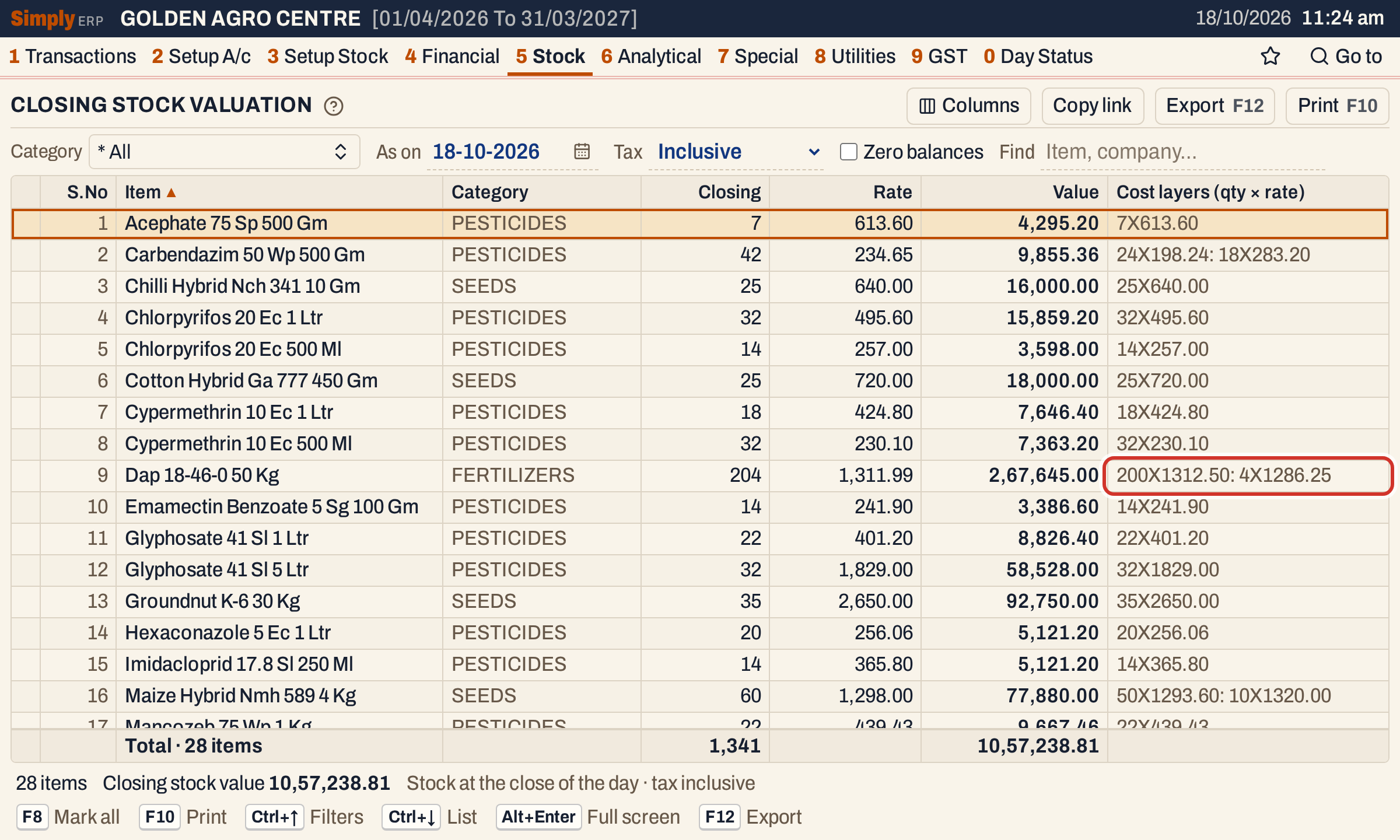 Enter on the Closing Stock line opens the valuation behind it. The last column shows the layers each item’s quantity was taken from, as quantity × rate.
The same valuation is the closing stock of the Profit & Loss Statement and the Balance Sheet, so the three reports always agree when they have the same As on date and Tax choice.
Open, print and export
- Enter on an account opens its ledger from the first day of the financial year to the As on date.
- Enter on Closing Stock opens the Closing Stock Valuation as on the same day with the same Tax choice. A closing stock you typed is not carried there.
- F10 prints the account as TRADING A/c: the company heading, As On the date, the line giving how the closing stock was valued, then A/c Name, Debit and Credit, and the totals. The Group column is left out of the print.
- F12 saves it as an Excel workbook, with the figures as numbers and the Group column when it is shown.
- Alt+Enter gives the whole window to the list.
Updated 4 November 2026.