GSTR-1
On this page
GSTR-1 lists what you sold in a period, split into the tables of the GSTR-1 return: B2B, B2CL, B2CS, Exempt, HSN and credit and debit notes (CDNR). Each table is a view you choose, so you can check every figure against your bills before you file. For a whole month, SimplyERP also writes the filing JSON and Excel files from these same figures.
Open the report
Press Alt+9 for GST Reports, then B. The report opens on the month of the working date, from its first day to its last, in the B2B view. The pictures on this page are October 2026 on the sample books, with an inter-state bill to a customer without a GSTIN, a sales return, a credit note and a debit note added so that every table has a line.
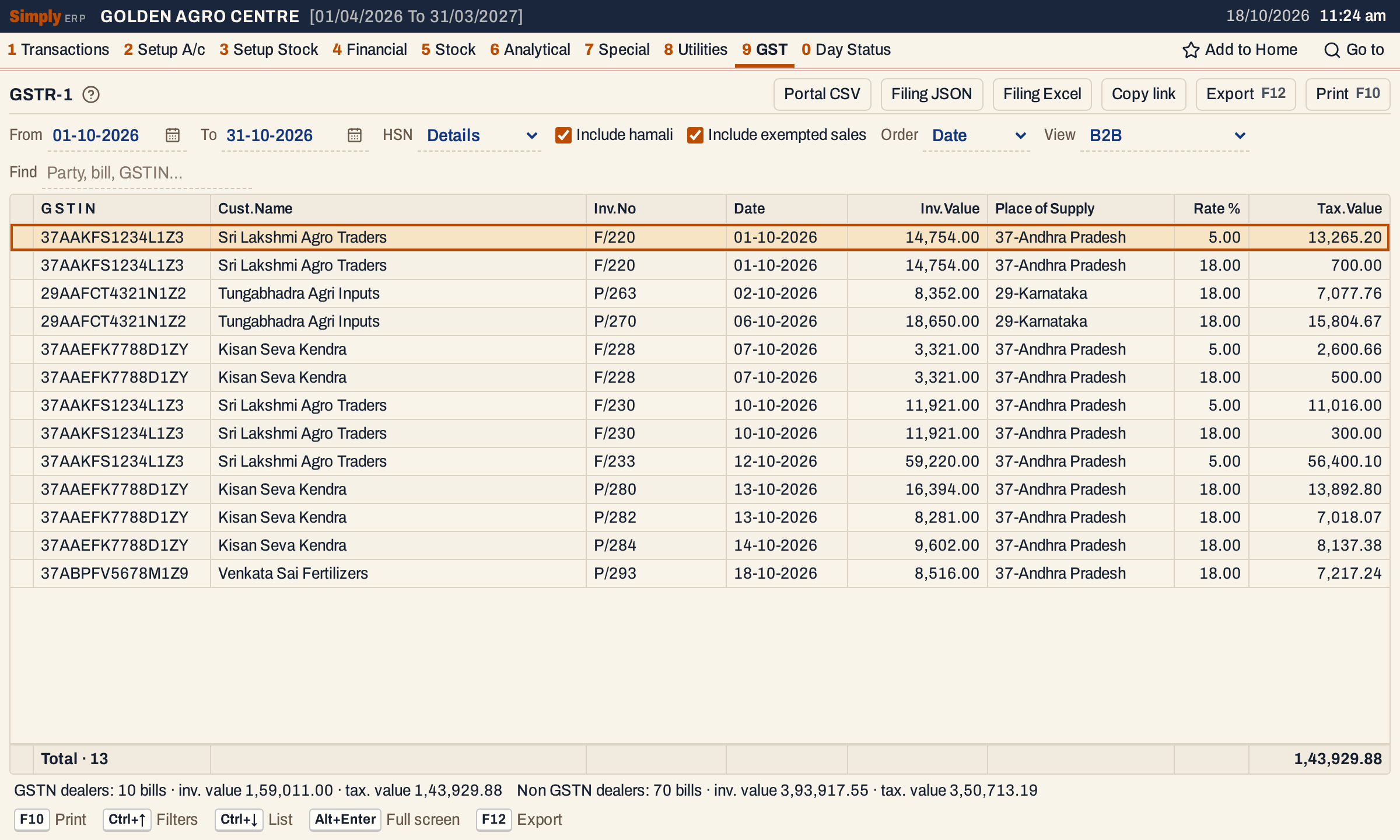 The B2B view. A bill with goods at two rates is one line for each rate: F/220 has goods at 5% and a charge at 18%.
What it lists
GSTR-1 reads the sale side of your books for the period:
- sale bills of every bill book, with their goods lines and the charges that carry GST (the Add + GST charges of Setup Stock N);
- sales returns, GST credit notes issued and GST debit notes issued.
A bill counts on its posting date, From and To both included. A sale is posted on its bill date. A sales return is posted on the day the goods came back, and its credit note goes in that period.
It does not read purchases (see GSTR-2), receipts, payments, journals or the non-GST credit and debit notes of 1 N and 1 O. The report works out no tax of its own: it adds up the amounts saved on the bills and notes.
Where each document goes
| Document | Customer | Table |
|---|---|---|
| Sale bill | Has a GSTIN | B2B, for any state and any value |
| Sale bill | No GSTIN, in another state, bill value above ₹1,00,000 | B2CL |
| Sale bill | No GSTIN, any other | B2CS, added up by place of supply and rate |
| A line at 0% GST (seeds, for example) | Any | Exempt, by inter-state or intra-state and registered or unregistered |
| Sales return, credit note, debit note | Has a GSTIN | CDNR, one line for each note and rate |
| Sales return, credit note, debit note | No GSTIN | Taken off or added to B2CS at its place of supply and rate; there is no separate table for them |
How the choices are made:
- Registered or not is whether the bill was made to a party with a GSTIN.
- Inter-state is a bill charged IGST, which is a customer in another state than your company’s.
- The B2CL limit is the bill’s total value above ₹1,00,000 (strictly more). For a bill dated before 1 August 2024 the limit is ₹2,50,000.
- A 0% line goes to Exempt whoever the customer is. For a customer without a GSTIN it goes nowhere else. For a customer with a GSTIN it is also listed in B2B, unless you untick Include exempted sales.
- A bill with several rates goes into its table once for each rate. The bill’s value is repeated on each of its lines and is counted once in the totals.
The views
View chooses the table. Each shows only the columns that matter on screen; the Portal CSV and the Excel export carry the fixed columns too (reverse charge, invoice type, cess and so on).
B2B and B2CL
The B2B view has these columns: G S T I N, Cust.Name, Inv.No, Date, Inv.Value, Place of Supply, Rate % and Tax.Value. Tax.Value is the taxable value of the bill’s lines at that rate. Inv.Value is the bill’s total as saved, with its charges and round off, so it is not always the taxable values plus tax. The B2CL view has the same columns without the GSTIN and customer name.
 B2CL: a cash bill to a customer in Karnataka with no GSTIN, ₹1,05,450.00 in all. It is inter-state and above ₹1,00,000.
B2CS
 B2CS adds up the bills of customers without a GSTIN, by place of supply and rate. Seeds at 0% are not here; they are in Exempt.
Columns: Place of Supply, Rate %, Tax.Value. The place of supply is the state of the customer’s address. A return or note to a customer without a GSTIN takes its taxable value off the line of its state and rate.
Exempt
 Exempt: October’s seed sales, all at 0%, to customers without a GSTIN in the shop’s own state.
Columns: Description, Nil Rated, Exempted, Non-GST. The description is one of four: Inter-State or Intra-State supplies to registered or Unregistered persons. Every line at 0% GST is added in Exempted, less returns and notes at 0%. Nil Rated and Non-GST are always 0.00: SimplyERP does not tell nil-rated, exempt and non-GST goods apart, it goes by the rate.
HSN
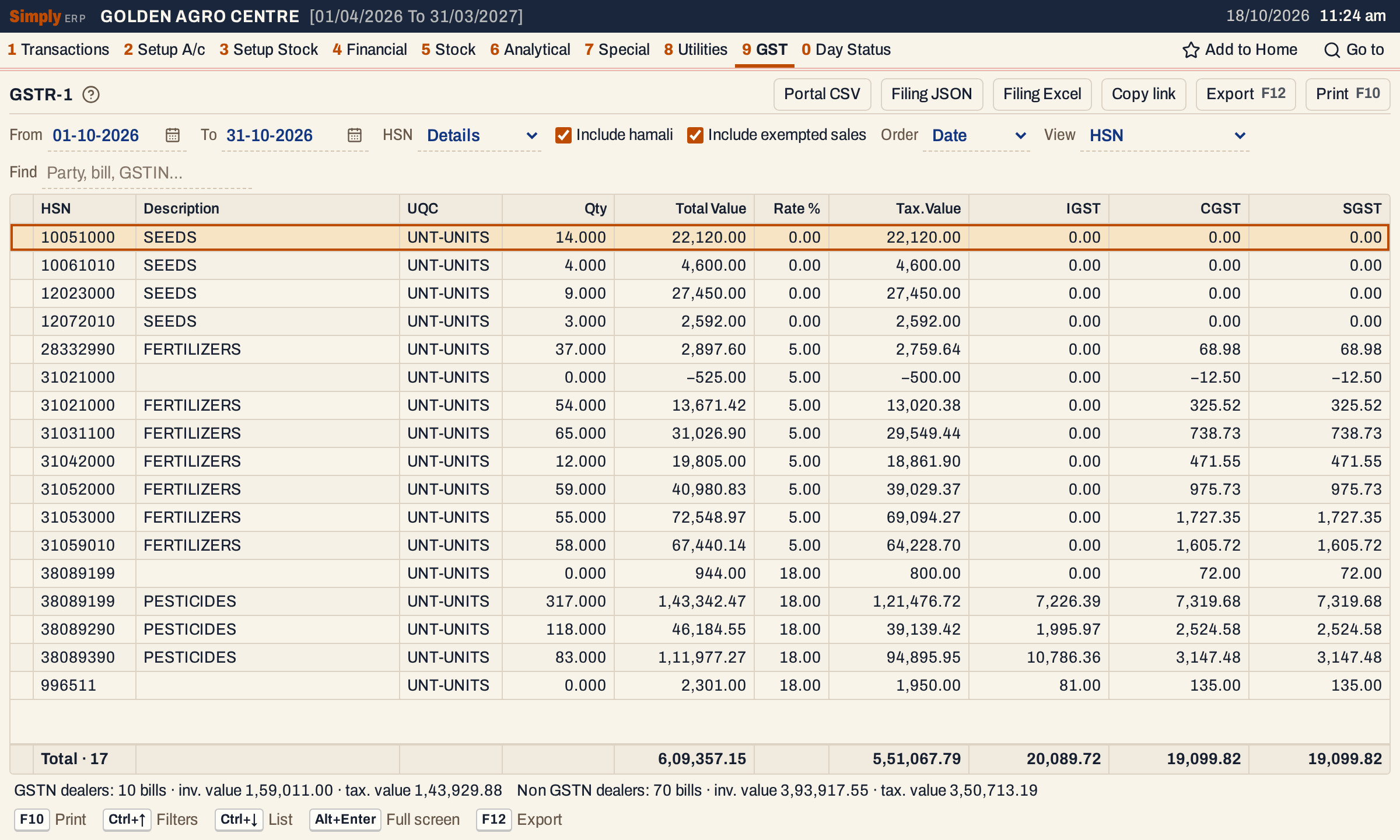 HSN with Details: a line for each HSN code, description and rate. The credit note’s Urea line is its own line with a blank description and negative figures.
Columns: HSN, Description, UQC, Qty, Total Value, Rate %, Tax.Value, IGST, CGST, SGST.
- The HSN code of a goods line is the item’s code as it is now. A note line has the code typed on the note.
- Description is the item’s category (SEEDS, FERTILIZERS and PESTICIDES in these books). A note line has no item: its description is the note’s category when the note covers one category, otherwise the narration typed on the line, which is usually blank.
- UQC is always UNT-UNITS, and Qty is the units billed. Charges and notes carry no quantity, except a sales return.
- Total Value is Tax.Value plus IGST, CGST and SGST.
- Returns and notes are included with their sign, so a credit note takes its amount off its code.
- A charge with its own code, such as the freight charge 996511, is a line of its own.
HSN in the choices changes the grouping. Details makes one line for each HSN code, description and rate. Summary makes one line for each HSN code and rate.
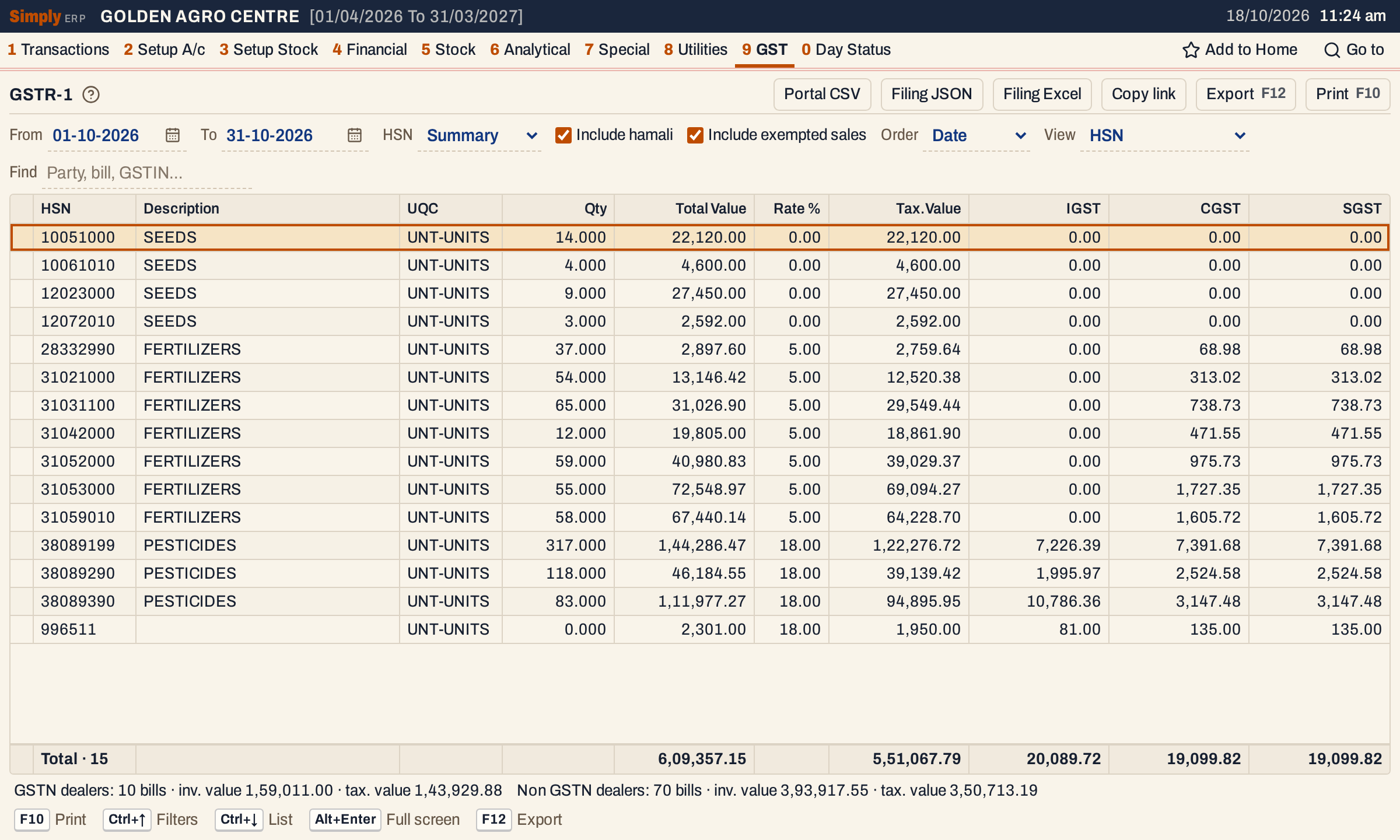 With Summary the credit note joins its code: 31021000 is 13,020.38 of sales less 500.00 of credit note, 12,520.38.
The HSN empty view lists the goods lines whose item has no HSN code: HSN Code, Product Name, Inv.No. and Inv.Date. Set the code on the item’s group (stock groups, 3 C). The filing files are not made while a line has no code.
CDNR
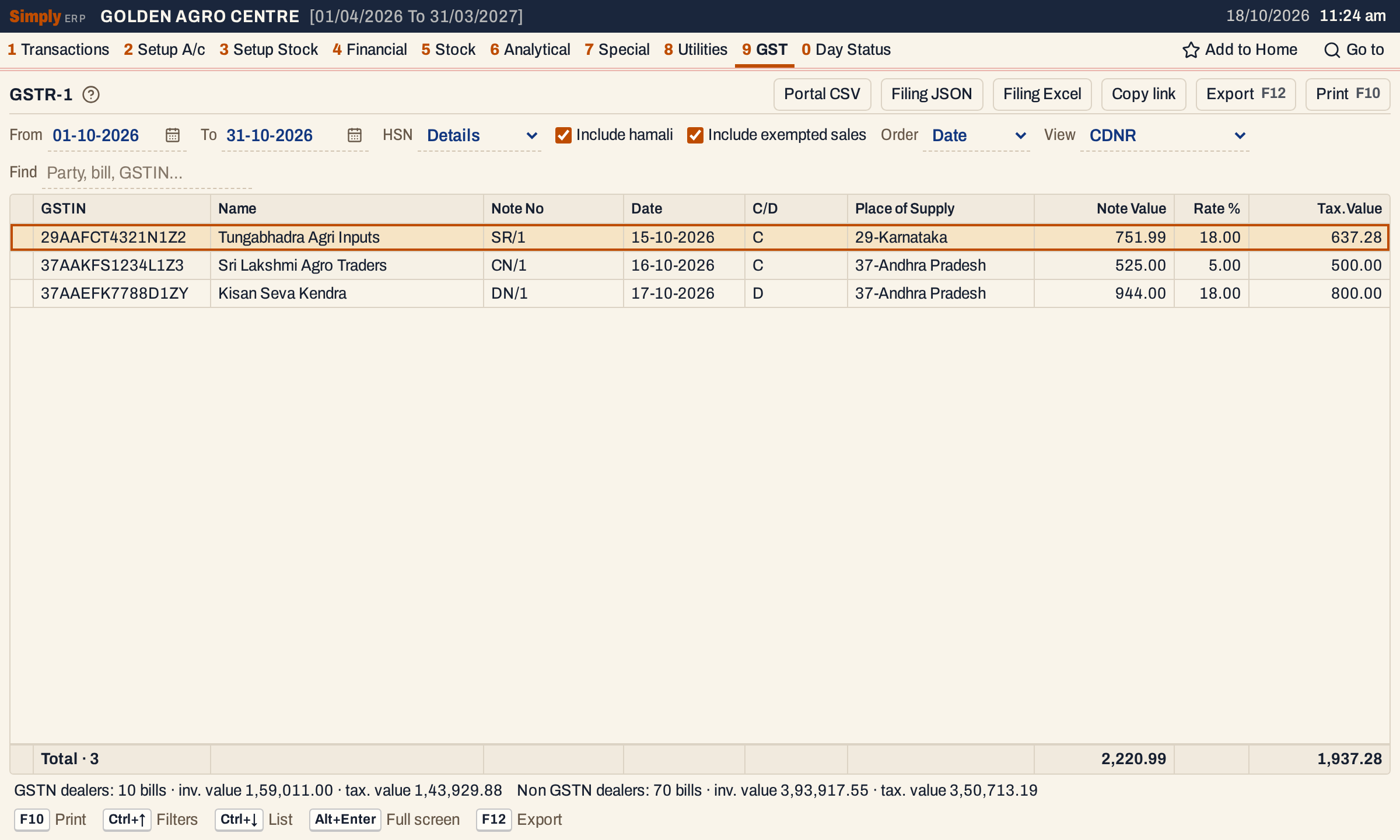 CDNR: a sales return (SR/1), a credit note (CN/1) and a debit note (DN/1) to customers with a GSTIN.
Columns: GSTIN, Name, Note No, Date, C/D, Place of Supply, Note Value, Rate %, Tax.Value.
- A sales return is listed as a credit note under your own series number (SR/1), not the customer’s return number.
- C/D is C for a sales return and a credit note, D for a debit note.
- Note Value and Tax.Value are shown without a sign. The notes’ figures are taken off (C) or added (D) in the HSN, B2CS and Exempt views.
- Only lines at a rate above 0% are listed here. A 0% note line goes to Exempt.
B2CS details and B2CS list
These two views list the bills behind B2CS, and they list every sale to a customer without a GSTIN, including the bills whose lines went to B2CL or Exempt.
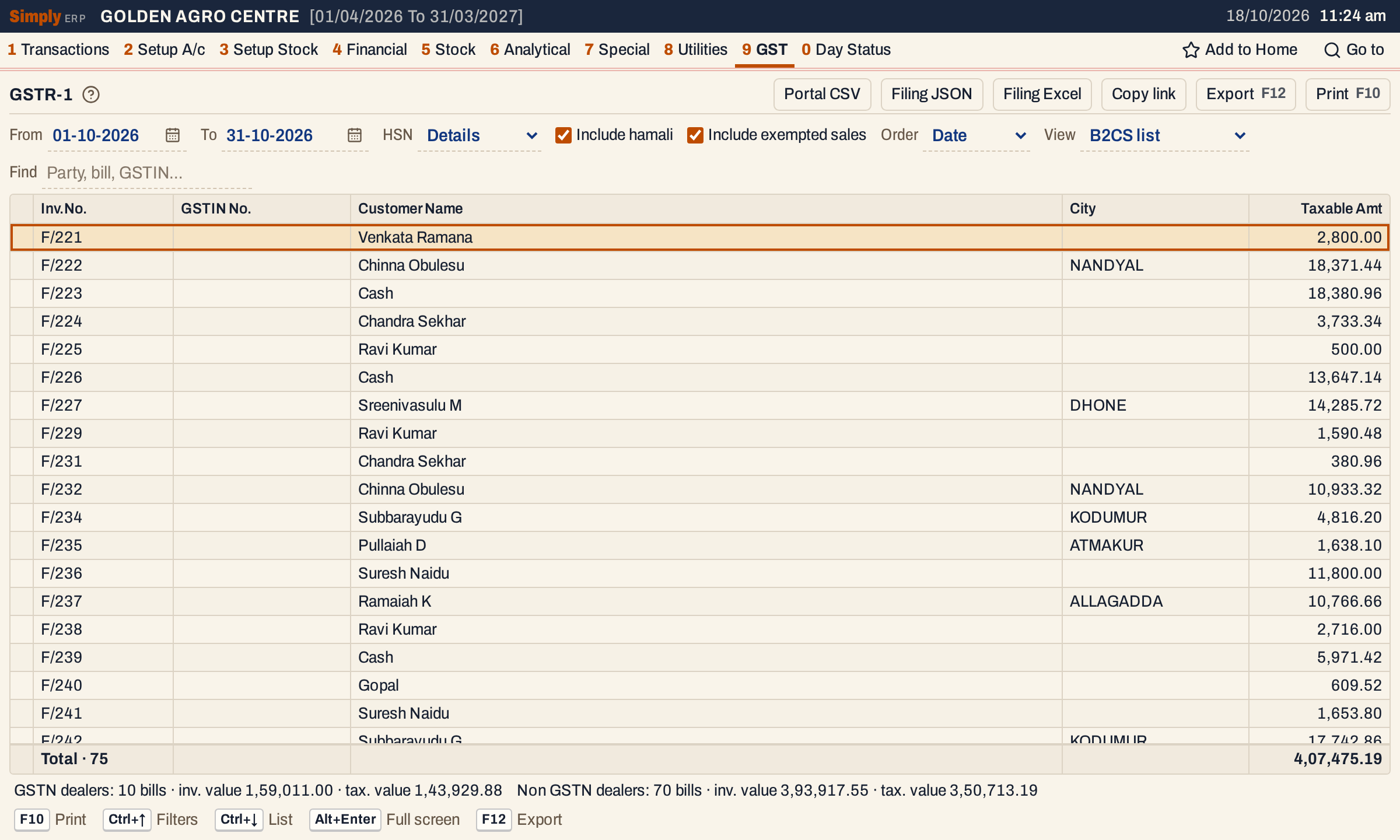 The B2CS list is one line for each bill. Its 4,07,475.19 is B2CS 2,61,348.79, plus Exempt 56,762.00, plus B2CL 89,364.40.
- B2CS list: Inv.No., GSTIN No., Customer Name, City, Taxable Amt for each bill.
- B2CS details: one line for each goods line: Date, Inv.No, Customer Name, City, Tax.Value, CGST%, CGST, SGST%, SGST, IGST%, IGST, Net Amt.
The totals under the list
The status line under the grid, the same in every view, gives two sets of figures:
- GSTN dealers: the bills in B2B, each bill’s value counted once, and their taxable value.
- Non GSTN dealers: the bills in B2CL and B2CS, the value of their lines with GST, and their taxable value. Notes to customers without a GSTIN are added with their sign, without counting as bills. Bills at 0% (Exempt) are not in this line.
In the October pictures there are 10 GSTN bills worth ₹1,59,011.00 with a taxable value of ₹1,43,929.88, and 70 non-GSTN bills worth ₹3,93,917.55 with a taxable value of ₹3,50,713.19: the 69 B2CS bills and the one B2CL bill.
Choices
 The choices above the list.
| Choice | What it does |
|---|---|
| From, To | The period, inside the financial year. Changing From moves To to the day before the same date next month, so a first of the month gives that whole month. |
| HSN | Details or Summary for the HSN view, as above. Default Details. |
| Include hamali | Ticked, a B2B bill’s value is its whole total. Unticked, the charges of the bill that carry no GST (the Add charges, such as hamali) come off Inv.Value. It changes bill values in B2B only. Default ticked. |
| Include exempted sales | Ticked, the 0% lines of a registered customer’s bill are listed in B2B as well as in Exempt. Unticked, B2B leaves them out and only Exempt has them. It changes B2B only. Default ticked. |
| Order | Date: by date, then series and number. GSTIN: by the customer’s GSTIN first. |
| View | B2B, B2CL, B2CS, Exempt, HSN, CDNR, HSN empty, B2CS details or B2CS list. Default B2B. |
| Find | Keeps the lines that match what you type in any of their columns: party, bill number, GSTIN, place and so on. |
Click a column title to sort by it, and click again to reverse. Every choice is kept in the page address, so Copy link opens the same report again.
How the figures are worked out
- Period. A bill is in the period when its posting date is from the From date to the To date, both included.
- Lines. Each goods line and each charge line that carries GST is read with its saved taxable value, CGST, SGST and IGST. SimplyERP adds them as saved. A sum is rounded to two decimals after each line is added.
- Tax.Value of a table line is the sum of the taxable values of the bill’s lines at that rate, after discounts and before GST.
- Returns and notes are signed. A sales return and a credit note count as minus, a debit note as plus. They are taken off or added in HSN, B2CS and Exempt, and listed unsigned in CDNR for customers with a GSTIN.
- Rate % is the line’s GST rate. A line whose tax rounds to nothing keeps its rate; only the rate 0 sends a line to Exempt.
- Place of supply is the state in the party’s address on the bill. A bill to a party with no state cannot go into the filing file.
- Bill value is the bill’s total as saved, which includes charges and round off.
- Check against GSTR-3B. The Tax.Value total of the HSN view and the Gross Amt of Output Totals in GSTR-3B read the same saved amounts for the same period. In the October pictures both are 5,51,067.79.
Filing files
For a whole calendar month (From is the first, To the last day), the buttons Filing JSON and Filing Excel appear beside Portal CSV.
 Filing JSON and Filing Excel appear only when the period is one whole month.
They are made from the same figures as the screen, with these choices fixed: customers’ 0% lines are in Exempt only, bill values are whole with their hamali, and the order is by GSTIN.
- Filing JSON has the tables B2B, B2CL, B2CS, CDNR, Exempt, HSN and Documents issued, version GST3.2.4. B2B and CDNR are grouped by the customer’s GSTIN, B2CL by place of supply. The HSN summary is by HSN code and rate, in one table for B2B customers and one for the others.
- Filing Excel is the same figures in a workbook with the sheets b2b,sez,de, b2cl, b2cs, cdnr, exemp, hsn(b2b), hsn(b2c) and docs, headings on row 4 and dates as DD-MMM-YYYY. A sheet with no lines is left out.
- Documents issued gives, for each series and kind of document (invoices, debit notes, credit notes): the first and last number, how many numbers that covers, and how many of them were not issued. See Invoice Series Status.
- Each line’s tax goes under the head its place of supply needs: IGST for another state, CGST and SGST for your own.
A file is not made when it would be wrong. The message names what to correct, the first five problems at most:
- the company’s GSTIN is not set in Company Details (8 A);
- a bill or note has no place of supply;
- a bill charges CGST and SGST to another state, or IGST within the state;
- a line at 0% charges tax, a B2B bill has a negative taxable value, or a note line has no positive taxable value;
- an item has no HSN code;
- a table does not add up to the register it was made from, or the supply tables do not add up to the HSN tables.
Portal CSV writes the lines of the view as a CSV file named by the view and period, for example gstr1-b2b-2026-10-01-2026-10-31.csv. The first row has the field names (gstin, party, invoice_number, date and so on), every value is in quotes, dates are YYYY-MM-DD and amounts have no commas. It also has the fixed columns the screen leaves out, such as reverse charge N and invoice type. It writes the lines that match Find, in the order shown.
What GSTR-1 does not cover
- No CDNUR table. Notes to customers without a GSTIN are netted into B2CS and Exempt.
- No tables for exports, supplies to SEZ units, e-commerce supplies, advances or changes to an earlier month.
- Reverse charge is always N and the invoice type is regular. Cess is zero and the e-commerce GSTIN is blank.
- Nil Rated and Non-GST are always 0.00; every 0% line is Exempted.
- SimplyERP does not file the return. It writes the files for you to upload.
Open, mark, print and export
- Enter on a line opens its bill or note. It works where a line is one document: B2B, B2CL, CDNR, HSN empty, B2CS details and B2CS list.
- F2 marks a line and F10 then prints only the marked lines.
- F10 prints the view as listed, with the period, the view’s name and your choices (HSN details or summary, hamali, exempted sales, GSTIN order, Find) in the heading.
- F12 saves the view as an Excel workbook, as it prints.
- Alt+Enter gives the whole window to the list.
Updated 4 November 2026.