Bill wise Analysis [Sales]
On this page
The Bill wise Analysis [Sales] report lists your sale bills for a period, bill by bill, under their days. Each day has its total, and each bill has its number, customer, city and bill amount. Use it to find a bill from its day, customer or city, or to see what each day’s bills came to.
Open the report
Press Alt+6 for Analytical Reports, then C. The report opens for the financial year from its first day to today, with every series and every payment, showing the bills.
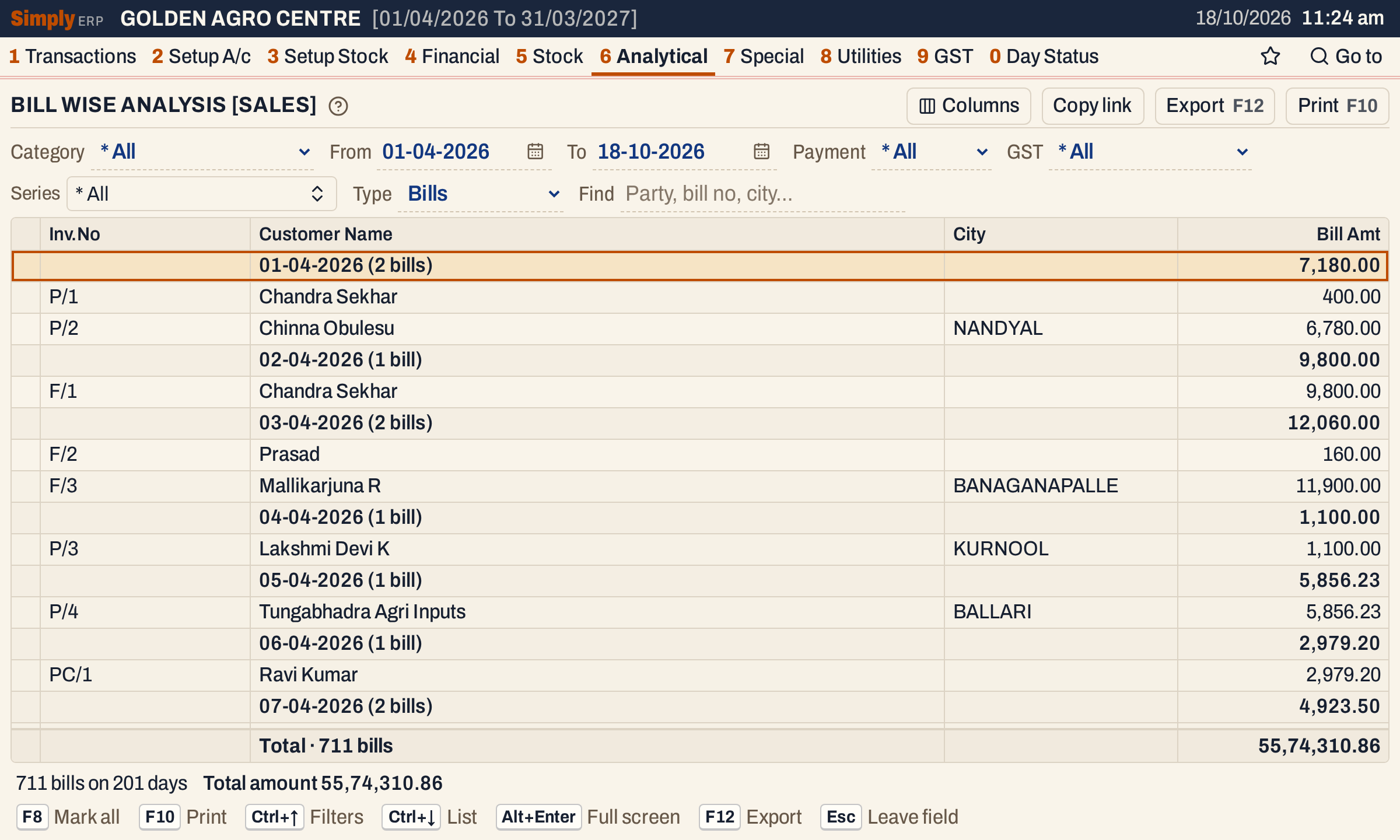 Each day is a line with its total. On 01-04-2026, two bills come to 7,180.00: P/1 for 400.00 and P/2 for 6,780.00.
What it lists
One line for each sale bill dated in the period, under its date. The report reads:
- sale bills of every payment mode, with at least one item line. A bill that has only charges and no items is left out.
- With the Type choice set to Returns, the sales returns of the period, each under the day it was received (Recd.), which can be later than the date typed on it.
Purchase bills, receipts, payments and goods delivered but not yet billed are not counted. A day with no bills is left out.
Columns
| Column | What it shows |
|---|---|
| Inv.No | The bill number: its series and number, such as P/2. |
| Customer Name | The customer on the bill. A bill with no customer name shows Cash / Counter Party. On a day line, the date with the number of bills in brackets. |
| City | The place written on the bill, blank when the bill has none. Shown by default; hide it with Columns. |
| Bill Amt | The bill’s amount, as worked out below. On a day line, the total of that day. |
The totals line under the grid adds up the Bill Amt of every bill, and the status line gives the number of bills, the number of days and the total amount.
Choices
| Choice | What it does |
|---|---|
| Category | Only the bills with an item of this category. The default is * All. A bill counts in full, with all its item lines, not only the lines of that category. |
| From, To | The period, both days included. Both dates must fall in the financial year. |
| Payment | * All (the default), Cash or Credit: only the bills paid in cash, or only those on credit. Bills paid by card or wallet are listed only under * All. |
| GST | * All (the default), Registered (customers with a GSTIN on the bill) or Unregistered. |
| Series | The invoice series to show. The default is * All. Choose one or more: the picker lists the series, each selection updates the report at once, and Done closes it. F2 on the field opens the picker. Changing Type clears it. |
| Type | Bills (the default) or Returns, the sales returns of the period. |
| Find | Shows only the bills whose customer name, bill number, city, series, payment mode or day (typed as 2026-10-18) matches what you type. Every word must be found in one of these; a word of three or more letters also matches when its letters appear in that order close together. |
Payment and GST narrow the bills before anything is added up.
Click the title of Inv.No, Customer Name or City to sort the bills within each day, and click again to reverse. Click Bill Amt to put the largest first: the days then come in the order of their totals, largest first, and each day’s bills in the order of their amounts.
 The choices of the report as it opens.
Series
Open the Series picker to choose series. Here only P/ is selected, and the list shows the four series of the period: F/, P/, PC/ and S/.
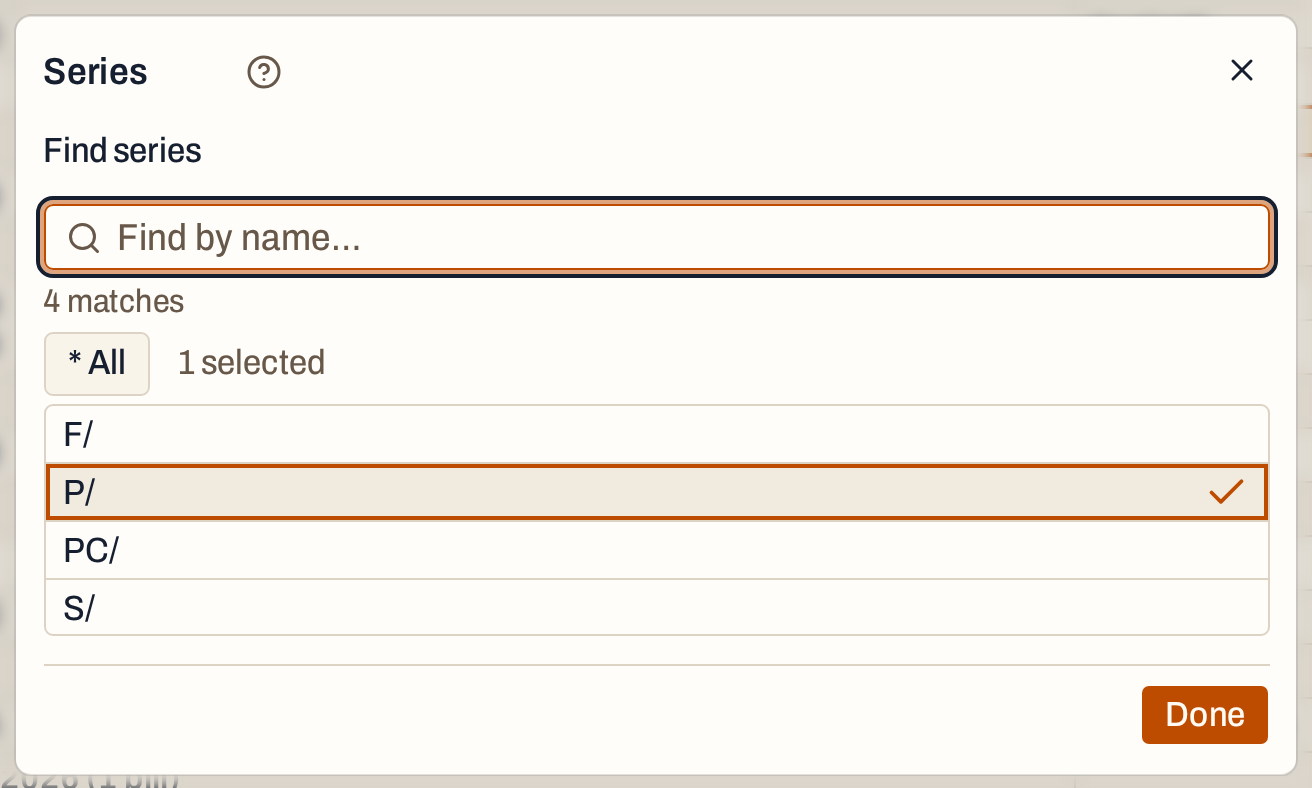 The Series picker. Find series narrows the list when there are many.
With P/ selected, the report shows 295 bills on 164 days, totalling 14,24,561.18.
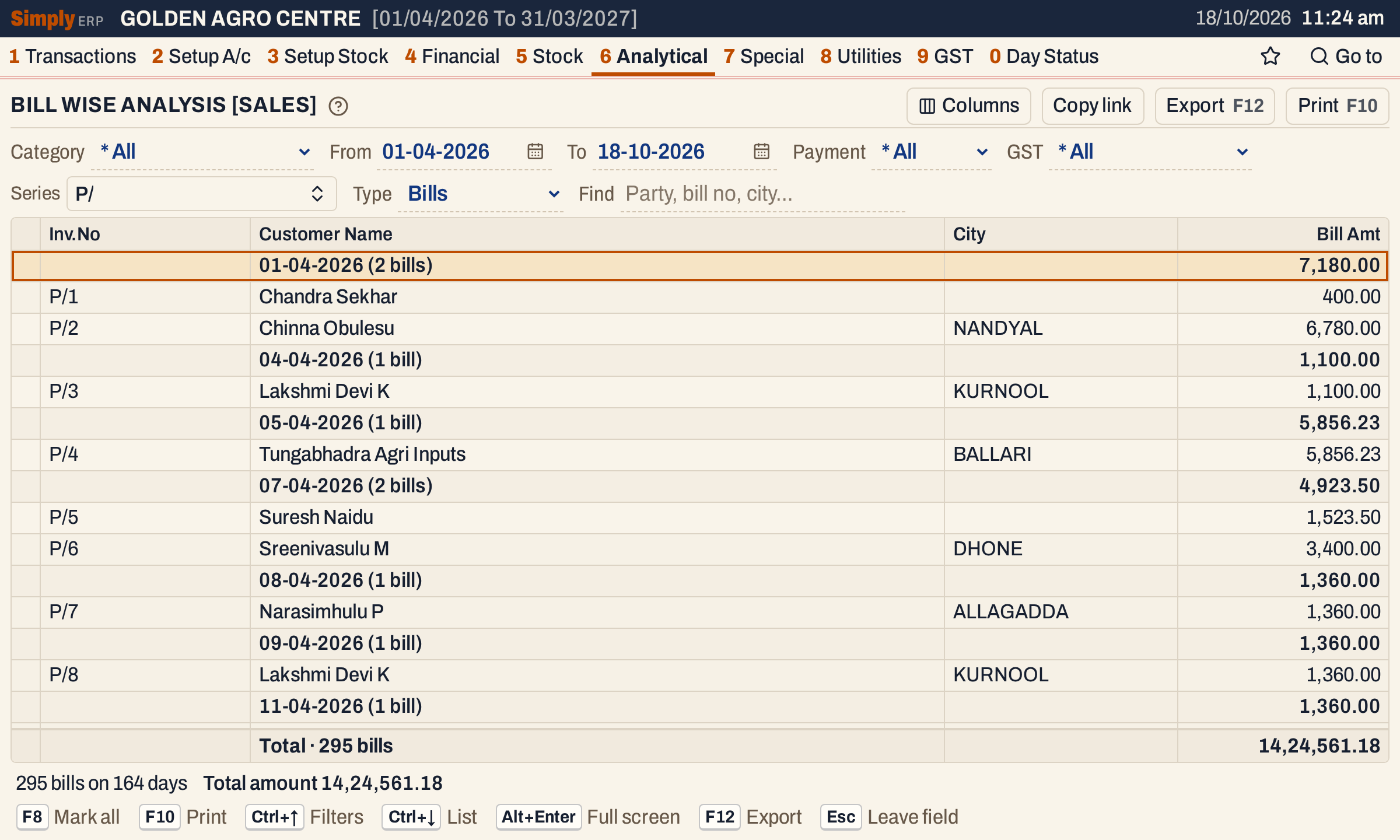 The same report with only the P/ series. The other series are left out.
GST: registered customers
Choose Registered to see only the bills to customers with a GSTIN. Here 97 bills on 78 days come to 26,17,151.18.
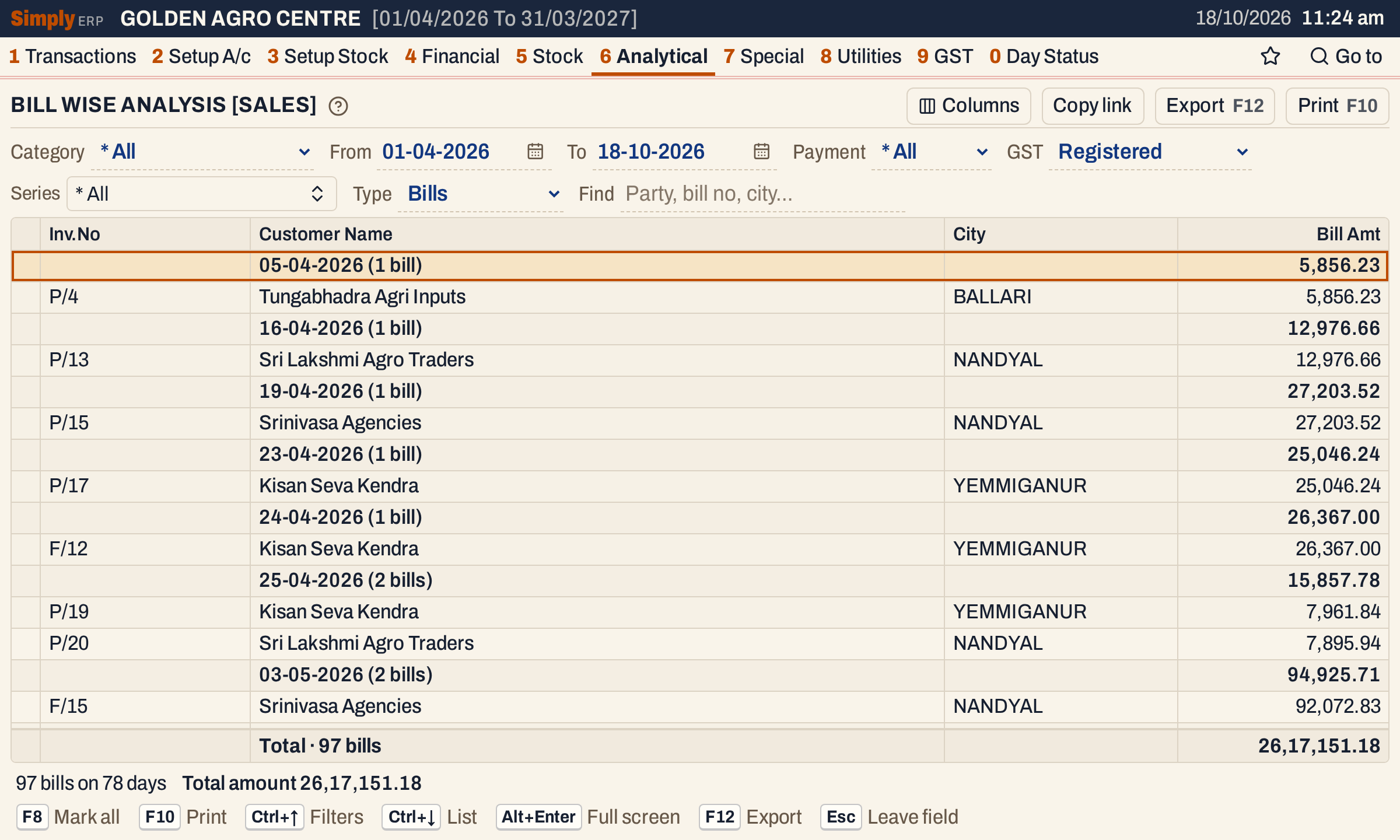 Registered customers only.
Returns
Choose Returns in Type to see the sales returns of the period, under their days. Here three returns were received on 18-10-2026, totalling 2,617.98. The title changes to Bill wise Sales Returns.
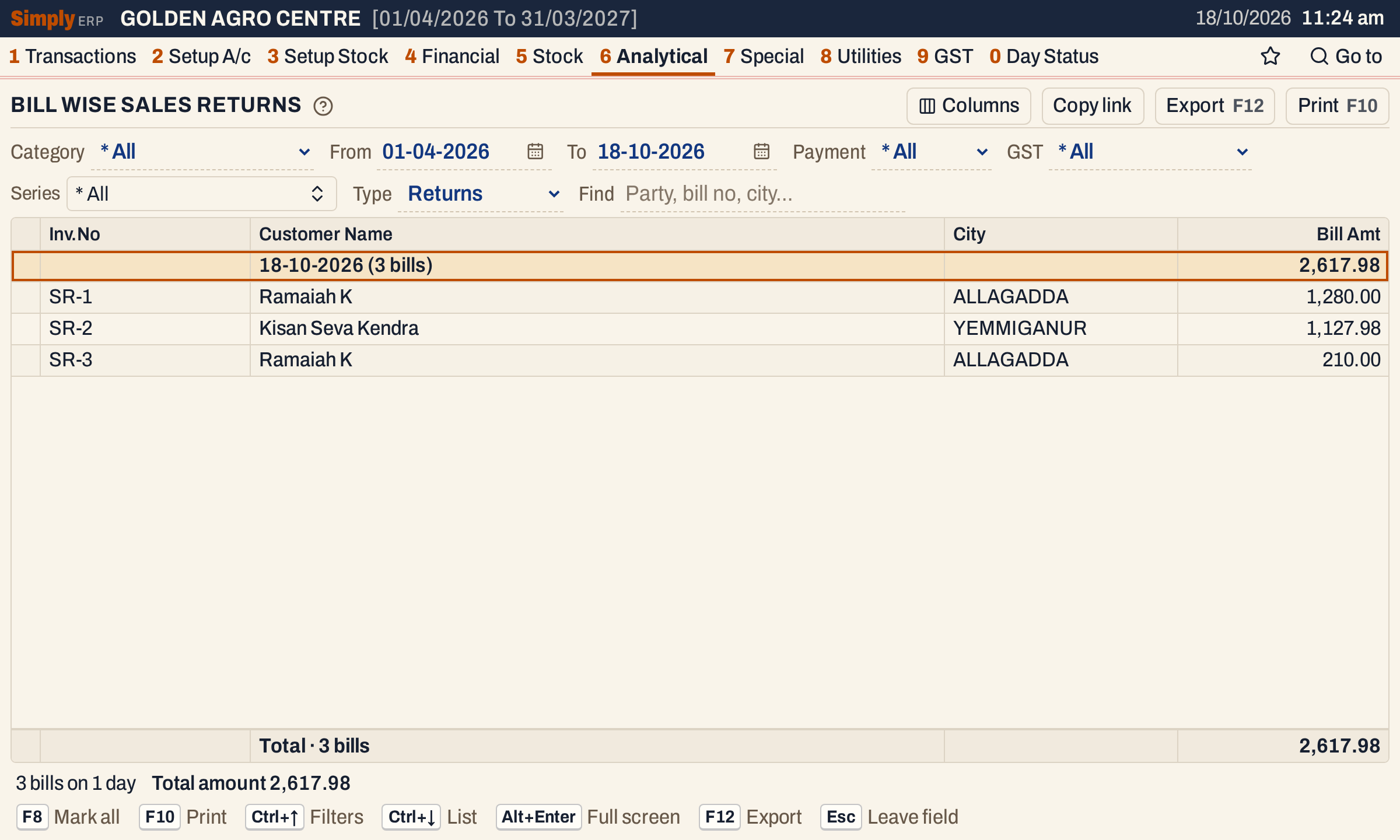 The three sales returns of 18-10-2026. Their amounts are the return totals as saved.
Find
Type in Find to narrow the list. Here the word chandra leaves 24 bills on 21 days, totalling 1,37,379.40.
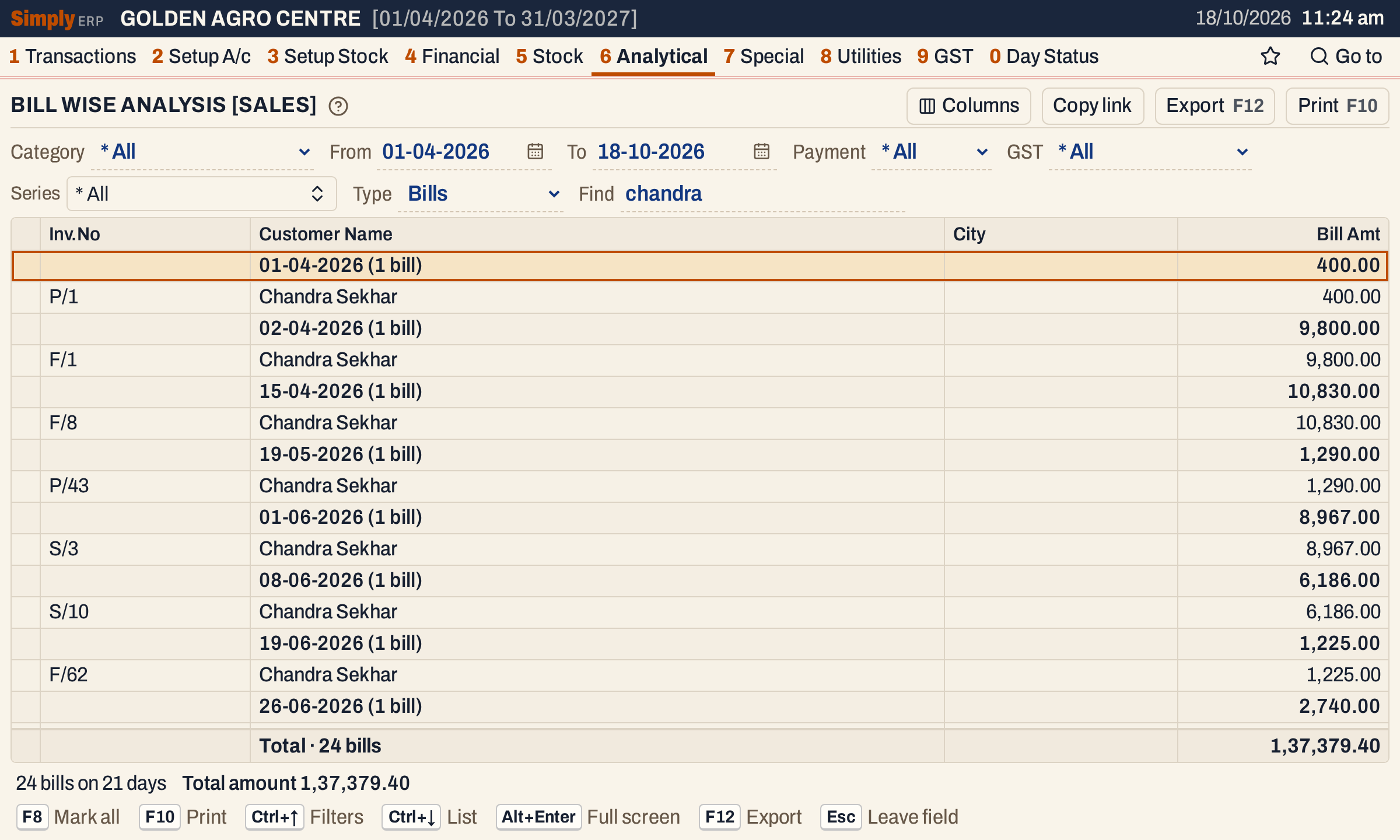 Find searches each bill’s customer name, bill number, city, series, payment mode and day.
How the figures are worked out
For each sale bill in the period, with the Payment, GST, Series and Category choices applied, SimplyERP works out its Bill Amt from its item lines only:
- A bill to a customer without a GSTIN: each item line counts its net amount, after discounts, which includes GST.
- A bill to a customer with a GSTIN: a taxed item line counts its gross amount (the line before discount and before GST) plus its CGST, SGST and IGST, so a line discount is not taken off. An item line with no GST counts its net amount.
- Charges such as freight, and any other line that is not an item, are not counted in Bill Amt. They are part of the bill’s total in the books, but not here.
So for a registered customer the Bill Amt includes GST, while Sales Analysis shows those sales before GST. The day total is the Bill Amt of its bills added up, and the Total line adds up the days.
With the Type choice set to Returns, a return’s Bill Amt is the return’s total as saved, with its charges and GST.
This report does not always add up to Day to Day Sales with tax included. For the period in these pictures, Day to Day Sales shows 55,78,369.86 and this report 55,74,310.86. The difference, 4,059.00, is the GST on charges such as freight: Day to Day Sales counts it, and this report leaves the charges out.
 The totals line adds up every bill; the status line gives the number of bills, the days and the total amount.
Open, mark, print and export
- Enter on a bill opens that bill. Alt+← returns to the report, with the cursor on that bill; Esc on the bill goes to the bill list instead.
- F2 marks a bill and F8 marks every bill on the screen. When any are marked, F10 prints only those, and the print says Marked bills only.
- F10 prints the report as it is on the screen, under the title DAILY SALES STATEMENT (DAILY SALES RETURNS STATEMENT for returns). Each day prints with its bills and a Total Day Sales line (Total Day Returns for returns). The columns are Inv.No., Customer Name, City and Bill Value, and the heading gives the period, the category, and the Payment, GST, Series and Find choices in words.
- F12 saves it as an Excel workbook.
- Alt+Enter gives the whole window to the list.
Updated 4 November 2026.